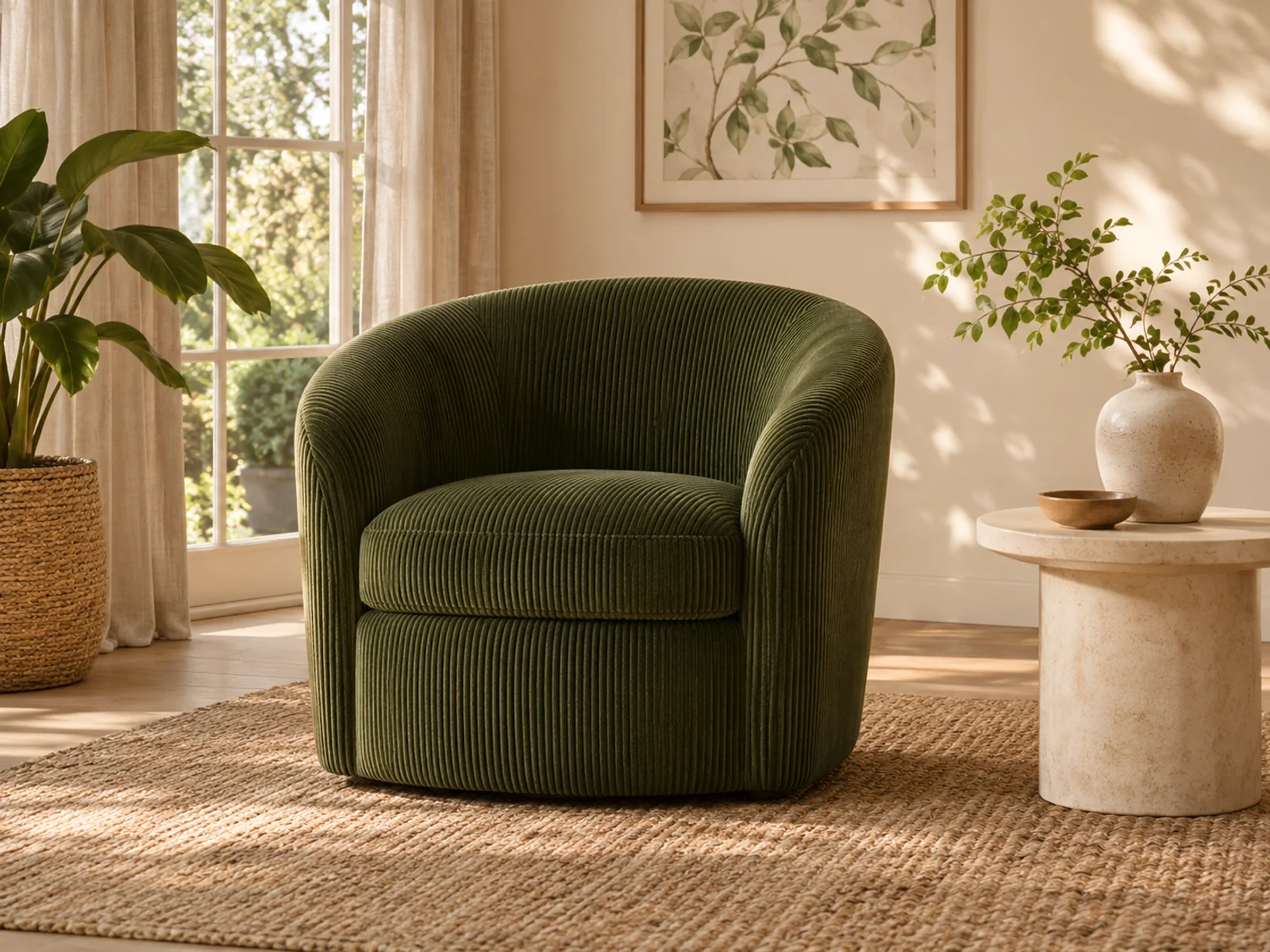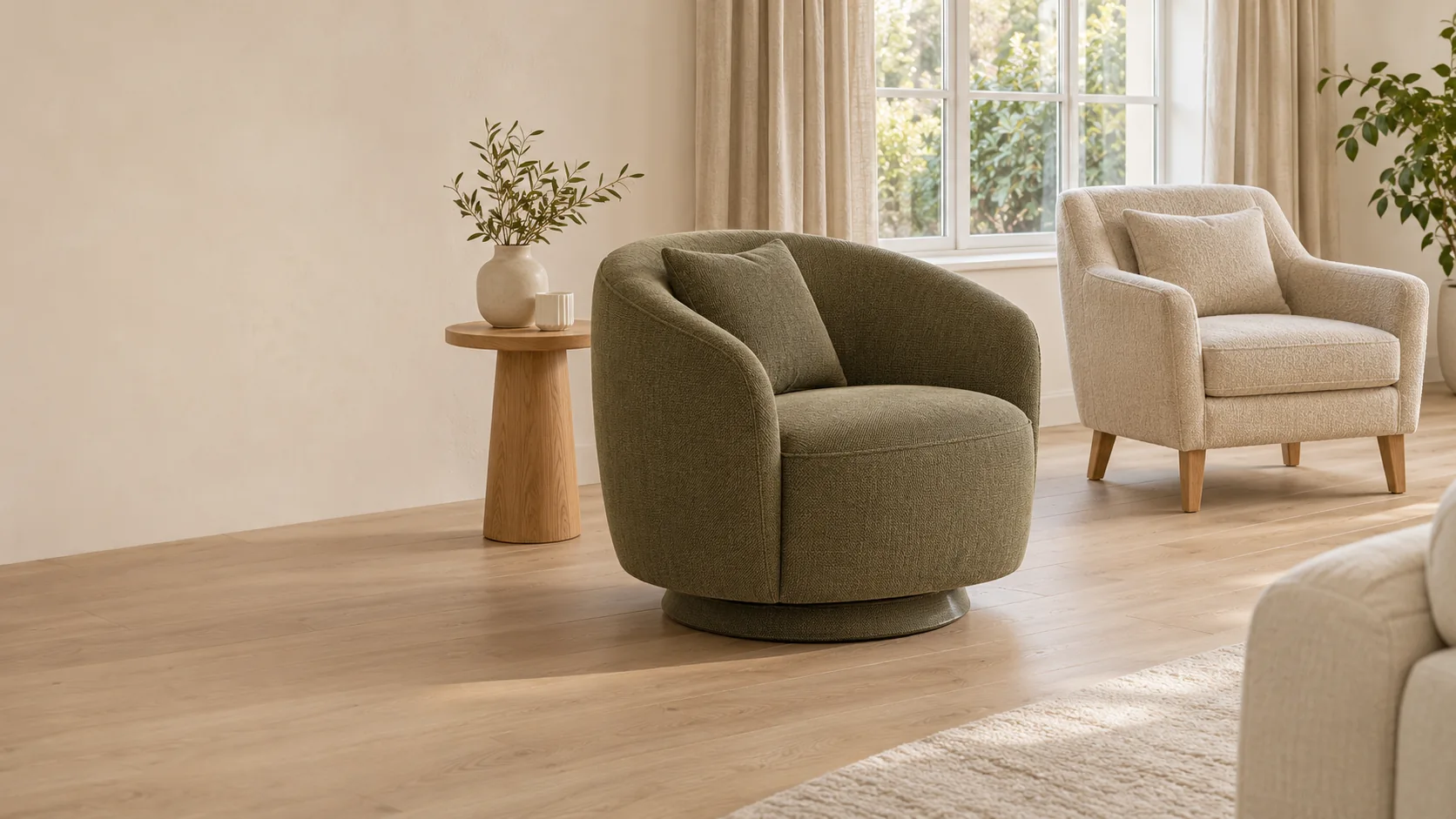
Identify the reason to turn
Draw the views the chair needs to serve, such as the sofa, television and window. A swivel may make sense when turning between them is part of everyday use. If the chair always faces one direction, the mechanism may add little value.
Do not confuse swivel with rocking, gliding or reclining. La-Z-Boy's chair descriptions show how several movements can be combined. Confirm exactly which functions a particular chair provides and whether they operate independently.
Measure the turning envelope
The widest point of the chair can sweep farther out as it rotates. Include arms, a projecting back and any footrest in the movement area. A square footprint marked only in the forward position is insufficient.
Place the chair away from surfaces it could strike. Test nearby curtains, tables and walls through the permitted movement. Our recliner space guide is useful if the model also reclines.
Try the base and return behavior
Some chairs return to a starting position, while others stay where you leave them. Rotation range and resistance also vary. Ask for the exact specification and try the mechanism if a sample is available.
Check the approved floor surface and any leveling requirements. Do not add an aftermarket swivel base to a fixed chair without manufacturer approval. The original frame and support were designed as a complete assembly.
Keep the seat comfortable and useful
Try the cushion, seat height and arm position independently of the motion. A convenient turn does not compensate for a seat that does not suit you. Plan a drink surface within reach without placing it inside the sweep of the arms.
Compare swivel chairs with fixed armchairs using the room plan. Choose the movement because it serves a real sightline or conversation need.
Ask what the swivel enables
A swivel chair can turn between conversation, a view and a television without moving its base. That is useful only if the room has enough clearance and the user likes the motion. A fixed chair may feel simpler and offer more design choices. Sit in both and test how easily you stand up. Check whether the swivel returns to one position or stays where it stops; exact mechanisms vary. Do not infer a full circle of rotation from the word swivel alone.
Mark the turning envelope
Use tape to show the chair's widest point at several angles. Keep lamps, side tables, curtains and power cords outside that sweep. Check whether a rug edge catches the base and whether the chair turns smoothly on the intended floor. If the chair also rocks or reclines, test those as separate movements. A swivel that fits when facing the sofa may still hit a wall when turned toward the window. Read the maker's assembly and weight instructions before use.
Test the chair after it turns
Rotate the swivel chair toward each intended activity and notice whether its arm height, light and side table still work. A chair that turns easily may leave the user facing away from a reachable surface. A fixed chair can be moved occasionally if its weight and floor protectors permit it. Ask who will use the chair most and whether an unplanned turn could disturb them. Comfort, stability and the room's objects should decide the mechanism, not novelty alone.
Common questions
Do all swivel chairs turn through a full circle?
No. Rotation can be limited and some designs return to a home position. Check the range for the exact model instead of assuming a full rotation from the word swivel.
Can a swivel chair sit close to a wall?
Only if its full permitted movement clears the wall and other objects. Measure the sweep of the arms and back, not just the distance from the base to the wall.
Is a swivel chair also a glider?
Not necessarily. Swiveling turns the seat, while gliding is a separate motion. Some models combine them, so read the complete function list and operating instructions.
Can a swivel chair sit against a wall?
Only if the full turning arc clears it, or the chair is used within a limited supported range. Measure with the chair occupied and allow space for arms and cushions.
Is a swivel chair harder to repair?
It has a moving base that may need service. Check warranty and part availability for the exact model. A fixed chair has fewer moving parts but still needs sound construction.
Will it spin on a thick rug?
Test the actual base and pile. Some rugs impede movement or make the chair unstable. Follow the maker's floor guidance.
Can it serve as a desk chair?
Only if its height, support and movement fit the desk task. Many accent chairs are designed for lounging, not prolonged computer work.