
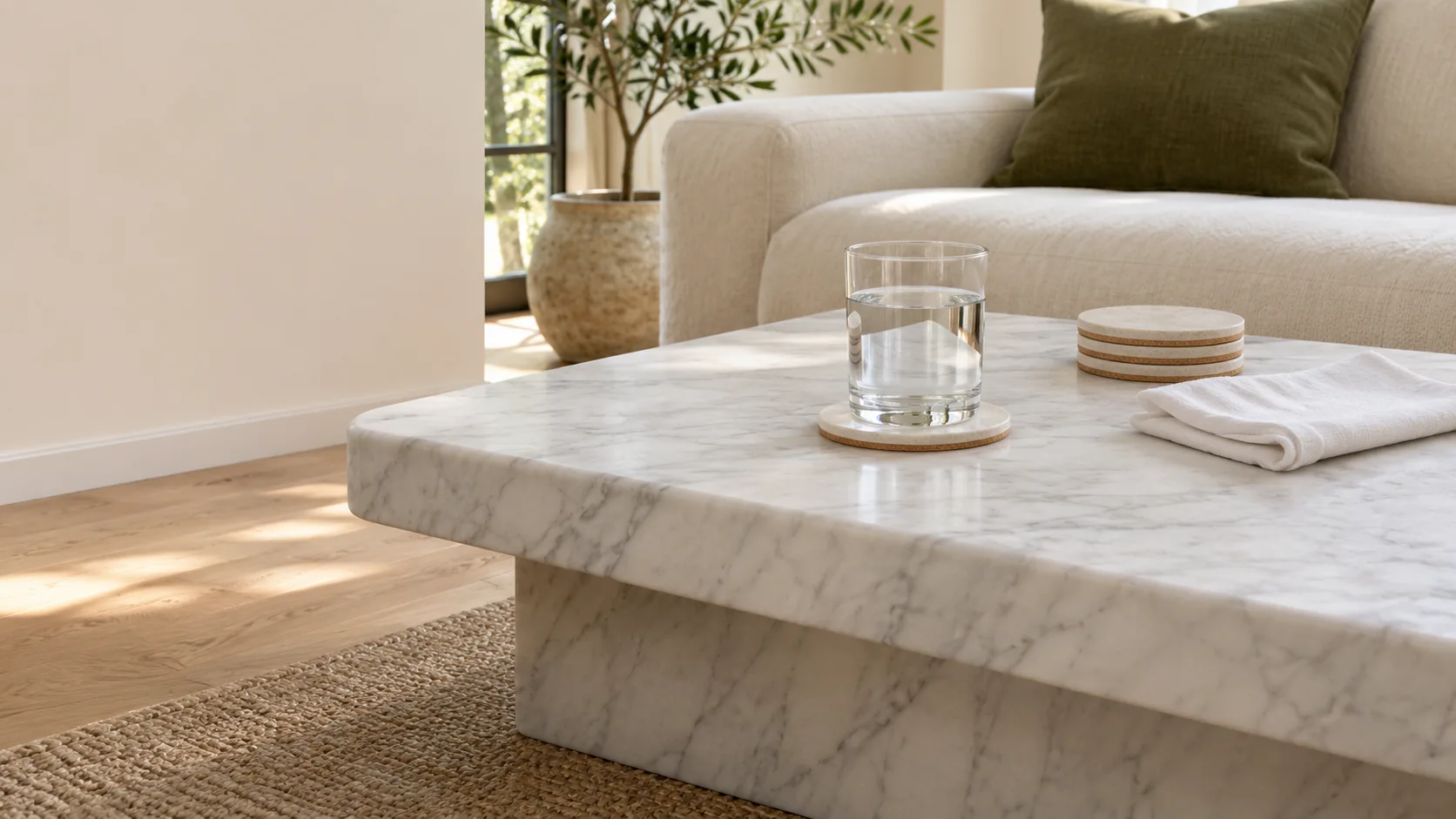
Confirm the material and surface treatment
A marble-look table may use ceramic, laminate or another material. A genuine stone top may also have a coating with its own care requirements. Save the product specification and ask whether the surface is sealed or otherwise treated.
Do not use a care recipe based only on the color or veining. The Natural Stone Institute care guide distinguishes stone types and warns that acidic products can damage acid-sensitive stone.
Make protection easy to use
Keep suitable coasters where people actually place drinks. Check that their backing is clean and compatible with the finish. Use the table maker's recommended protection beneath hot items and decorative objects.
Lift objects instead of sliding them across the top. Before putting down a planter or vase, inspect its base and consider whether moisture can collect underneath. Protection is more useful when it is part of the normal arrangement rather than stored elsewhere.
Respond to a spill without experimenting
Blot promptly and use the approved cleaner and drying method. Avoid vinegar, lemon-based cleaners and abrasive scrubbing. If the tabletop has a coating, its instructions take priority over a general routine for bare stone.
Keep a photograph of a persistent mark and note what was spilled. Do not mix cleaning products or move through progressively stronger remedies. Ask the supplier or a stone-care professional what the surface needs.
Separate a stain from a change in finish
A darker discoloration and a dull patch can indicate different problems. Cleaning harder will not necessarily restore a surface that has been chemically etched. Ask for a diagnosis before applying a poultice, polish or sealer.
Browse marble and marble-look tables with maintenance in mind. Our glass and wood comparison offers other material directions if you prefer a different care routine.
Identify the finish and protection
Ask whether the top is natural marble, engineered stone or a marble-look material. Get the specific care sheet and ask whether any sealant is present. The Natural Stone Institute's care guidance explains that natural stone surfaces vary and need appropriate cleaning. A sealed surface is not necessarily stainproof or immune to acidic spills.
Clean spills promptly and gently
Use coasters and trays, and blot spills rather than spreading them. Follow the table maker's approved cleaner and cloth instructions. Avoid acidic household products, abrasive pads and improvised stain remedies on natural stone unless a qualified stone professional recommends them for your finish. Test a permitted cleaner in an unobtrusive place first.
Protect the table structure
Check weight limits and whether the top can be lifted separately from the base. Stone is heavy and vulnerable to chipped edges; arrange enough help for moving it. Do not drag it across a rug or lift by a thin overhang. If you see a crack or a persistent stain, document it and ask the supplier or a stone specialist before further treatment.
Common questions
Does sealing make marble stain-proof?
No. A treatment should not be assumed to prevent every stain or acid-related mark. Ask what protection it provides and how it should be maintained on your exact tabletop.
Can I remove a dull patch with more cleaner?
A dull area may be an etch or another finish change rather than dirt. Stop repeated cleaning and ask for an assessment. Abrasive polishing without guidance can create a larger uneven patch.
Should I reseal the table every year?
Do not use a fixed schedule without checking the stone, finish and supplier's instructions. Some tops have coatings or treatments that require a different approach. Ask which product, if any, is approved.
Does sealing make marble stainproof?
No. Follow the exact care instructions and clean spills promptly.
Can I use vinegar?
Avoid acidic cleaners on natural marble unless the supplier explicitly approves them.
Will every mark polish out?
No. Marks have different causes. Ask a stone specialist to assess persistent damage.
Can I lift it alone?
Check its weight and construction; arrange help and follow the maker's handling instructions.