Measure where you actually sit
Measure the arm next to the seat that needs a table. On a sloped arm, note both the highest point and the area your hand passes over. If the sofa is armless, use your seated position and the task as the reference instead.
A table can look aligned in a photograph while being difficult to reach from a deep seat. Try the motion with an empty cup and a stable temporary surface. Check whether your elbow hits the arm or your shoulder has to reach backward.
Separate the height question from the size question
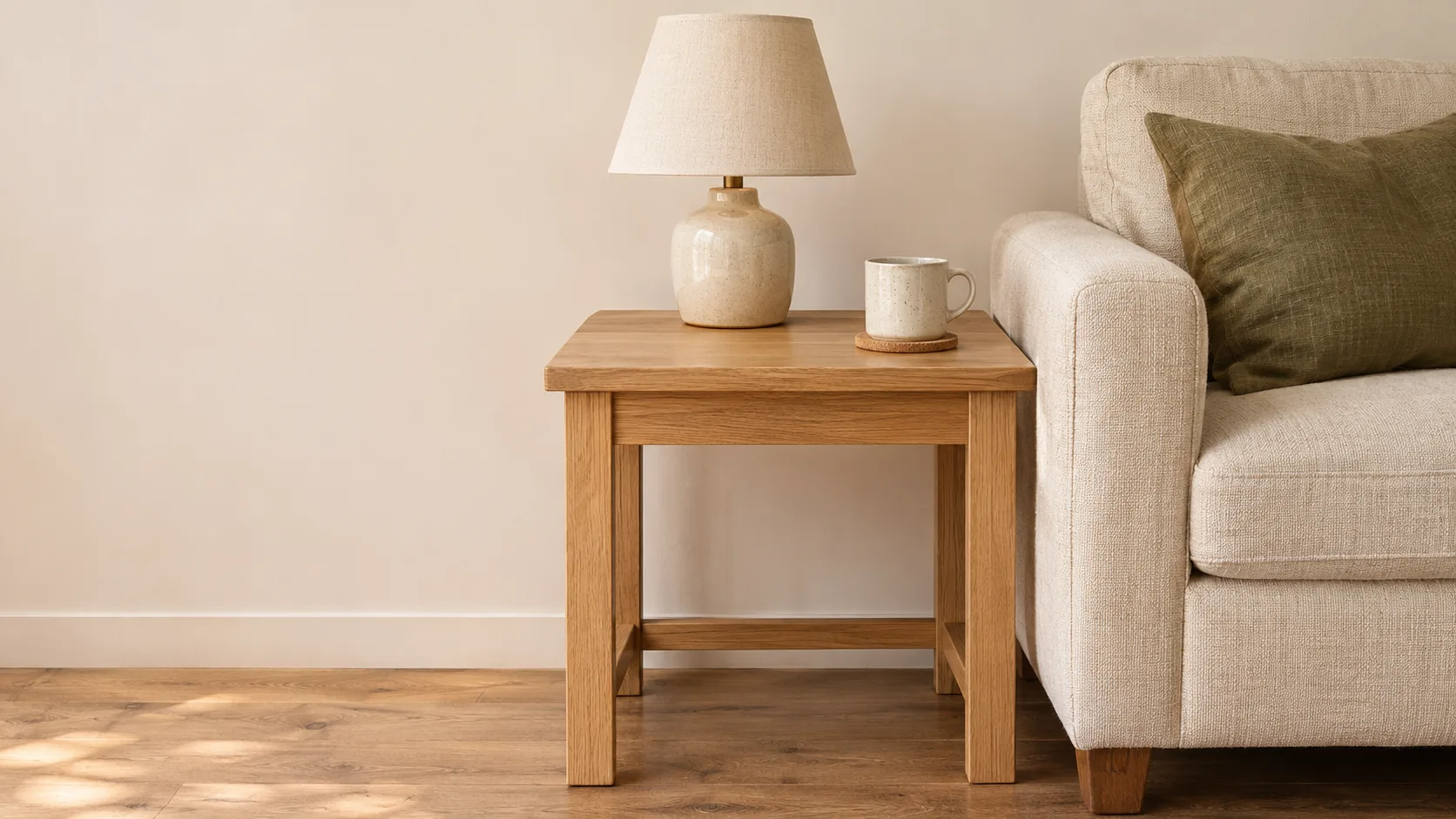
The right height does not guarantee a useful top. Draw the lamp base, coaster and other everyday objects at their approximate sizes on paper. Check whether you can still put down a cup without navigating a crowded arrangement.
Look at the base too. A wide lower shelf can interfere with feet even when the top fits beside the sofa. A narrow top on a broad pedestal may need more floor area than its headline measurement suggests.
Fit the table into the room
Check the gap beside the sofa and any nearby door, curtain or drawer. The table should not claim space needed to enter the seating area. A tall, heavy-looking design can also compete visually with a small chair, which is a styling consideration rather than a performance defect.
Our narrow side table guide is useful when width is limited. Compare height separately, since narrow tables do not all serve the same seated reach.
Plan the lamp at the same time
If the table will support a lamp, confirm that its base sits fully on the top. Try the combination from the reading position and check whether the shade obstructs a view or exposes a bright bulb. Route the cord so it does not cross a walking path.
For a broader room check, Room & Board's measuring guidance reminds shoppers to preserve access to outlets, vents and controls. A table placed neatly beside the arm can still block something you use daily.
Compare a small shortlist in place
Write down the proposed height, top dimensions and base dimensions for two or three candidates. Test them with a stable mock-up or a similar table you already own. Do not balance heavy objects on improvised stacks.
Choose the combination that works from the seat and leaves the room usable. Browse small side tables once you have a practical size range.
Measure from the arm that will use it
Seat and arm heights vary, so measure the actual sofa or chair from the floor. Put a temporary box or stack at a candidate height and try setting down a drink, reaching a lamp switch and picking up a book. A table slightly above or below the arm can work if the reach is comfortable. A narrow top may be more important than a precise height when the seat is against a wall. Check whether a table leg conflicts with a sofa foot or a heating vent.
For a reading chair, measure the lamp, shade and cable route together with the table. A good height for a cup may place a lamp's light too low or into someone's eyes.
Test stability and access
A tall, narrow side table can be easy to tip if a heavy lamp sits near the edge. Check the base shape, weight and floor contact. Leave enough room for drawers, recliner movement and a person standing up. If a table must be moved often, make sure its top is large enough for the objects it carries without becoming a hazard. Keep cords away from walkways and choose a surface that tolerates the household's cleaning routine. An attractive table is not helpful if it has to be shifted every time someone uses the sofa.
Common questions
Should two side tables be the same height?
They do not have to match. Different chairs or sofa arms may need different surfaces. Judge each table from its adjacent seat and use color, material or lamp styling to connect the pair visually.
Can I use a stool as a side table?
Possibly, if the top is stable, suitable for the objects you plan to place on it and rated for that use. Check the finish and shape, especially before placing drinks or a lamp.
Is a tall table easier to use?
Only if it suits the arm and your reach. A table that rises well above the arm may force you to lift a cup awkwardly. Test the movement rather than assuming extra height helps.
Should the table be level with the sofa arm?
That is a useful starting point, but the comfortable reach depends on the person, arm shape and object. Test two nearby heights using a temporary surface before buying.
Can a lamp make a low table work?
A taller lamp can help with light placement, but check stability and glare. The table still needs to be reachable for drinks, remotes or books without awkward leaning.
What if the sofa arm slopes?
Measure from the seat and test a temporary surface at two nearby heights. A sloping arm gives no single reference point. The best height lets the user reach a drink and lamp switch without twisting or knocking objects while standing.
Can I pair tables of different heights?
Yes, when each serves the adjacent seat. Repeat a material or shape to make the pair feel connected, then check that both are stable and reachable. A matched set is less useful if one chair has a much higher arm.