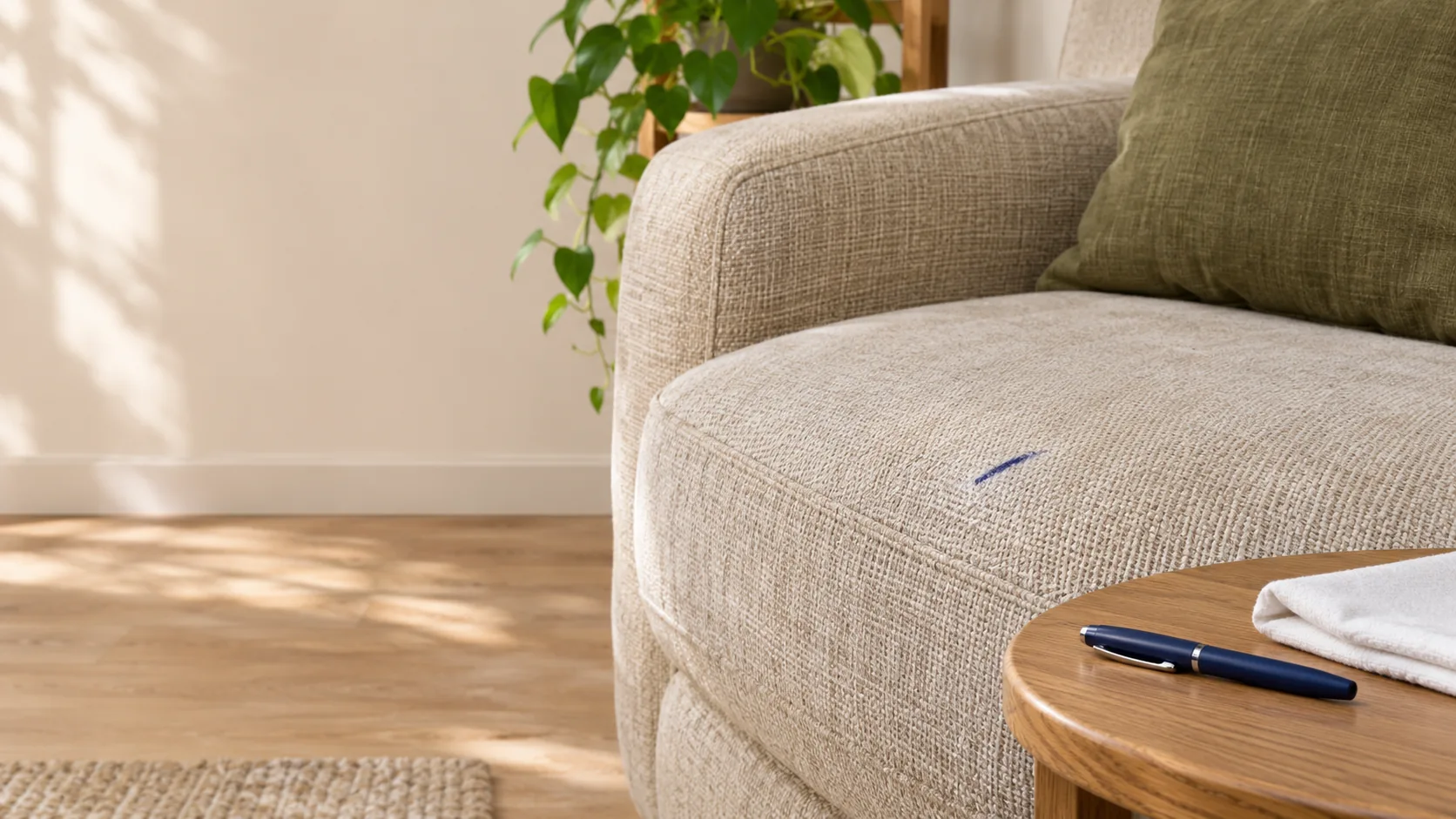
Record the stain before treating it
Move the pen away and photograph the mark. Note whether it is ballpoint, gel or marker ink if you know, when it happened and whether anything has already been applied. Those details are more useful to a cleaner than a long list of attempted remedies.
Avoid rubbing the mark or spreading fresh ink into neighboring fabric. Keep the area out of use while deciding what treatment the upholstery allows. Do not add water simply because the stain is small.
Read the upholstery instructions
Find the material description and cleaning code. Ashley explains the common fabric cleaning codes, including water-based, solvent-based and vacuum-only care. A code narrows the cleaning approach but does not approve every product within that category.
For leather, identify the finish rather than relying on its color or softness. Our leather couch guide explains why a material description matters when comparing upholstery.
Choose a treatment for the actual surface
Furniture Clinic gives different ink-treatment guidance for different leathers, including aniline and pull-up finishes. Read the product restrictions and ask the supplier to confirm compatibility before using it on an unidentified couch.
Do not transfer advice for finished leather to suede, coated fabric or woven upholstery. Hairspray, nail-polish remover and hand sanitizer are not interchangeable upholstery products. Their availability at home does not establish that they are suitable.
Test, then inspect before continuing
If the manufacturer approves a treatment, follow its hidden-area test and drying instructions first. Use an inconspicuous part of the same upholstery, since the underside may be a different material. Check the dry result for shade, sheen, texture and color transfer.
Treat the visible mark only after a satisfactory test and use the specified amount and technique. Stop if the ink spreads, the couch color lifts or the finish becomes sticky. Repeatedly adding stronger products can leave a larger problem than the original line.
Give a specialist a clear history
For an old mark, delicate upholstery or an uncertain finish, send a professional the photographs, label and list of previous treatments. Ask what improvement is realistic and whether treatment could alter the surrounding color.
Do not promise yourself a completely invisible result. Some marks may remain, and an honest assessment is more useful than continuing until the original material is damaged.
Identify the ink and surface first
Ballpoint, gel and marker inks are different stains, and fabric, leather and coated upholstery respond differently. Record when the mark appeared and whether it is still transferring. Check the care label and manufacturer instructions before treating. Ashley Furniture's care guide is a reminder to follow the specific upholstery code. On leather, a specialist product such as Furniture Clinic's ink remover has its own material limits and directions; it is not a universal remedy for fabric.
Test in a hidden area and work small
Use a clean white cloth and the approved treatment in a discreet location, then let it dry to check colour and finish. Do not flood the mark or rub it outward. If the ink moves onto the cloth, turn to a clean face instead of putting colour back on the sofa. Keep solvents away from the filling and nearby finishes. For valuable furniture or an unknown textile, a professional may be less risky than a home mixture of alcohol, detergent and water.
Stop if the stain changes shape
Inspect the dry result in daylight. A growing halo, softened coating or lost colour means the method is harming the surface. Do not keep adding product to chase the last trace of ink. Photograph the result and note every treatment for a professional cleaner. For daily prevention, keep pens capped near the sofa and place a writing surface on a side table. A small ink mark is easier to live with or professionally treat than a large damaged area.
Keep the test result with the care record
Note the product name, time applied and result on the hidden test. If the mark does not respond, a professional will need that information. Do not try another solvent immediately, because residues can interact or move dye. Let the area dry completely and protect it from use in the meantime. If the sofa belongs to a shared or commercial space, report the damage and follow its cleaning policy instead of experimenting on an expensive surface.
Common questions
Will rubbing alcohol remove pen ink?
It may affect some inks, but that does not make it safe for your upholstery, dyes or finish. Use it only if the furniture and treatment instructions specifically permit it for that material and stain.
Can I wash a zippered cushion cover?
A zipper does not establish that a cover is washable. It may be there for assembly. Follow the specific care label before removing, washing or drying a cover, even when the stain is limited to one cushion.
What if I already used a household cleaner?
Stop adding products and record exactly what was used. Let a suitable upholstery specialist know the product and any visible change. That history helps them assess the mark and avoid incompatible follow-up treatments.
Does old ink always come out?
No. The ink, material, finish and previous treatments affect the result. A specialist may be able to reduce the mark, but complete removal without a change to the surrounding surface is not guaranteed.